

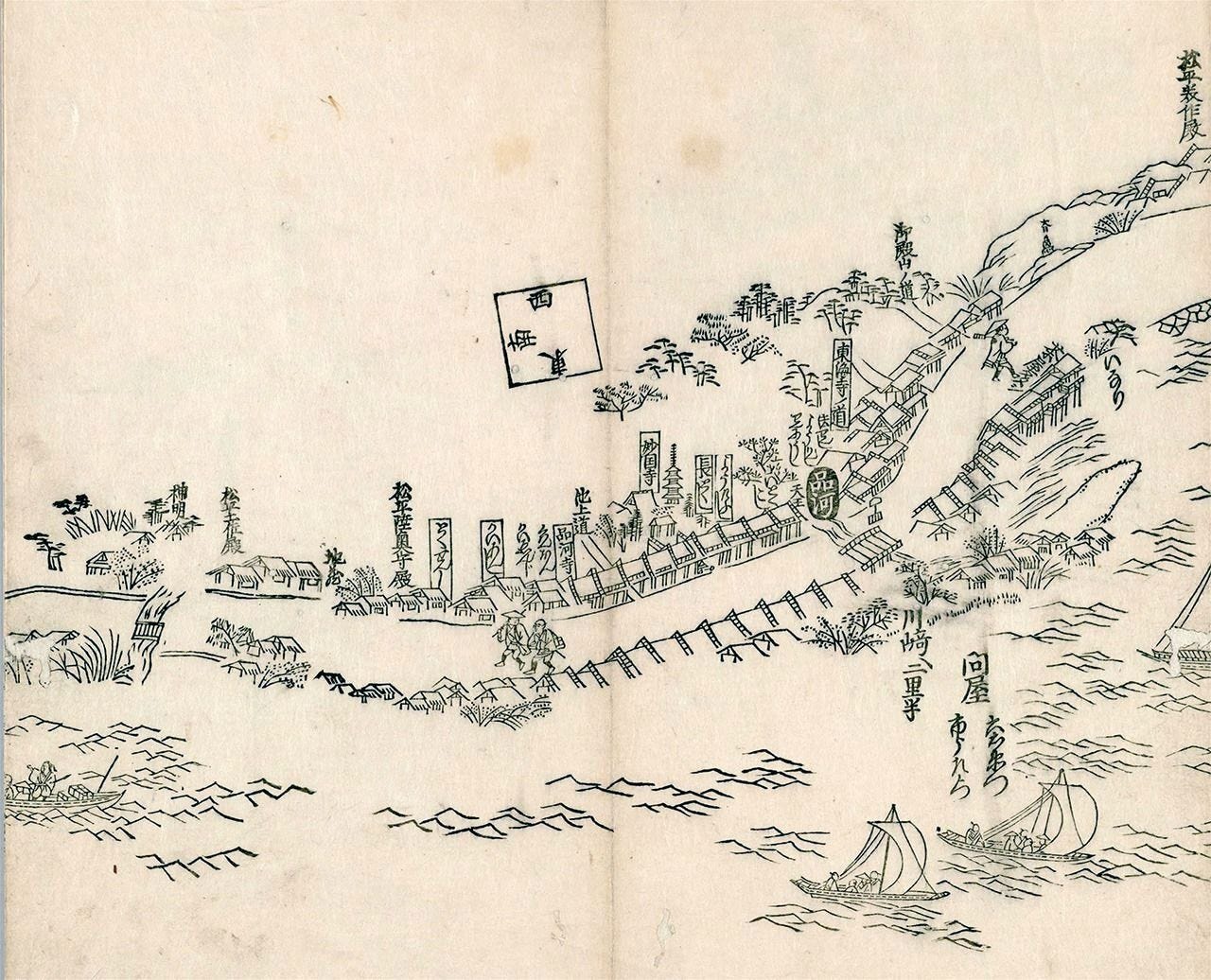
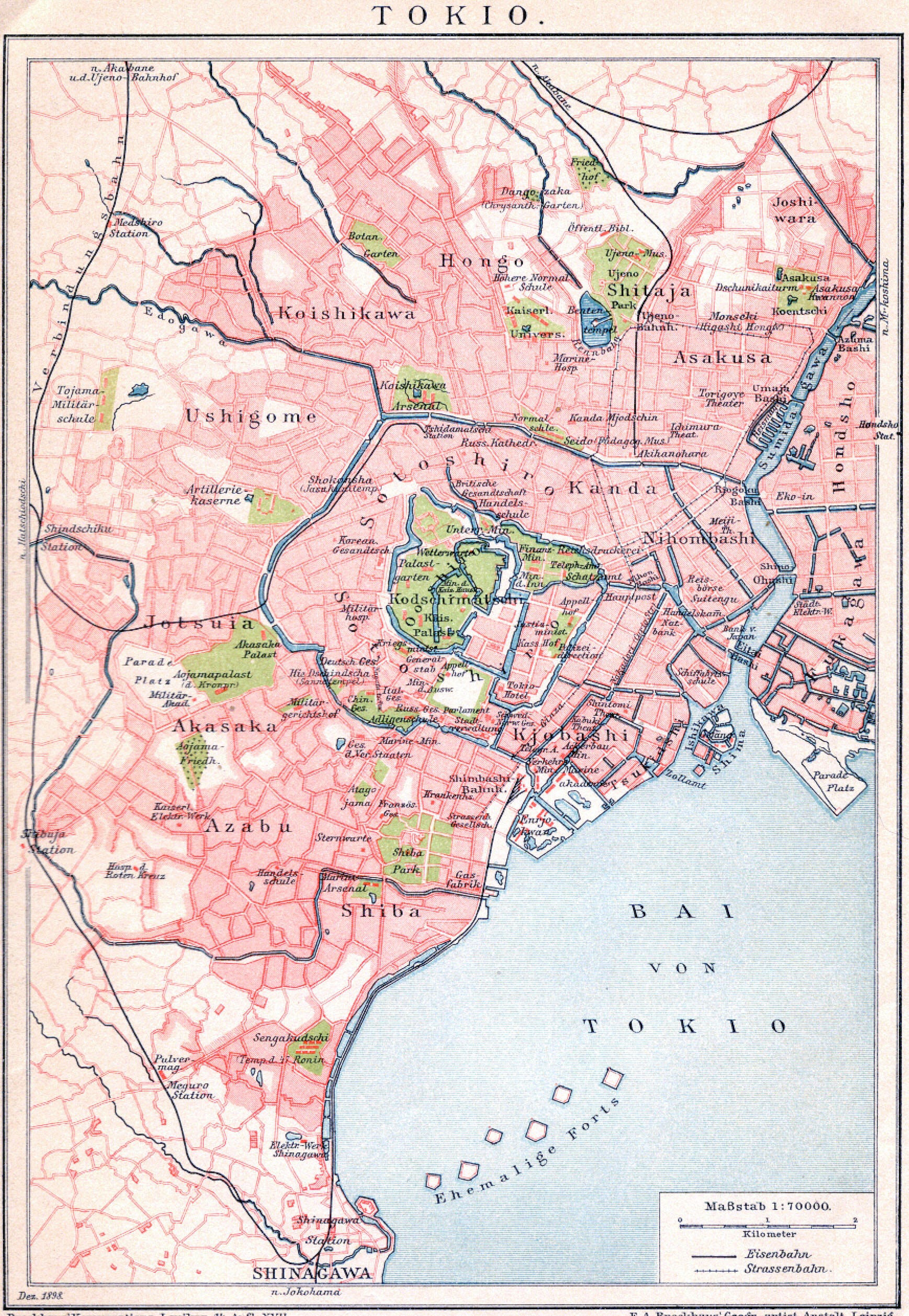
Dear readers, following my latest report on my Yamanote Line walks, I’m posting a few more postcards, maps, and excerpts that should give you a better idea of what Shinagawa looked like more than 100 years ago.
The first excerpt is from Potter’s American Monthly: ‘Japan and Her People’, 1879.
Skirting the bay by a decent road, we perceive how shallow the water is hereabouts; sand banks and mud flats being left above water as the ride recedes. Soon the Tokaido is entered, and after passing Kanagawa, we next reach Kawasaki, a small village on the Yedo [Edo, Tokyo’s old name] road. It now becomes apparent we are approaching an important city by the crowds of wayfarers which throng the road. Presently we reach Shinagawa …
Here the elite of the Yedo aristocracy were accustomed to seek amusement, and lounge, admiring the beauties of Yedo Bay, the prospect of the city being very fine from this point.
The activity inseparable from life in and near a great city shows itself at Shinagawa. The tea-house and flower-girls invite the passing traveler to rest and repose himself. Tea and confectionery and music, such as it is, are tempting to the wayworn.
The traveler descends; he mounts the steps; takes his seat on the balcony, and feels disposed to enjoy the splendid view here presented of the calm waters of the bay, with the busy fleet of native and foreign craft, and the slopes of the city covered with palaces beyond, while the neat-handed Phillis [country girl] hands him tea and pipes.
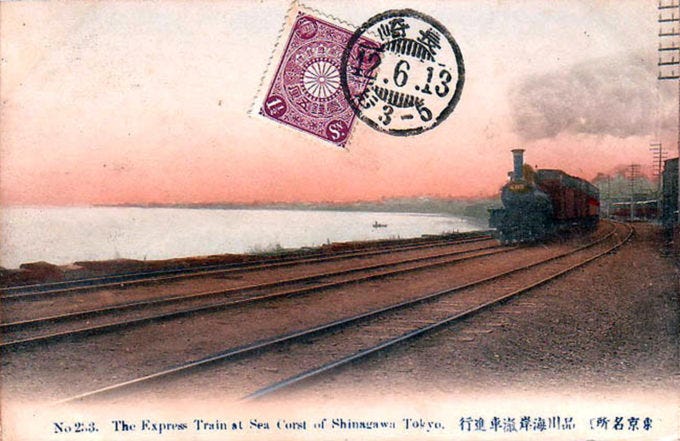
The next one is from “In Those Days,” by Tayama Katai, Thirty Years in Tokyo, 1917 (translated by Kenneth G. Henshall, 1987)
I [was] enchanted by the sight of the little steam train threading its way along the coast from the direction of Shinagawa, spilling out its grimy smoke. In those days there was only one railway line in Japan, and that was between Tokyo and Yokohama. And there were songs in fashion like the one that went:
The train’s setting off – sai, sai,
Leaving its smoke – sai, sai:
Isn’t it horrid, all this smoke! – sai, sai.’
The train was still a novelty even for city dwellers. It was around this time that the Frenchman Pierre Loti came to Japan, and really insulted the Tokyo-Yokohama train – or rather, looked upon it with pity – and said, ‘A train, in Japan! A tiny little train! A rickety-rackety, one-jarring little train!’ But nevertheless, pathetic little train that it was, it did represent the first major enterprise of the Japanese government.”
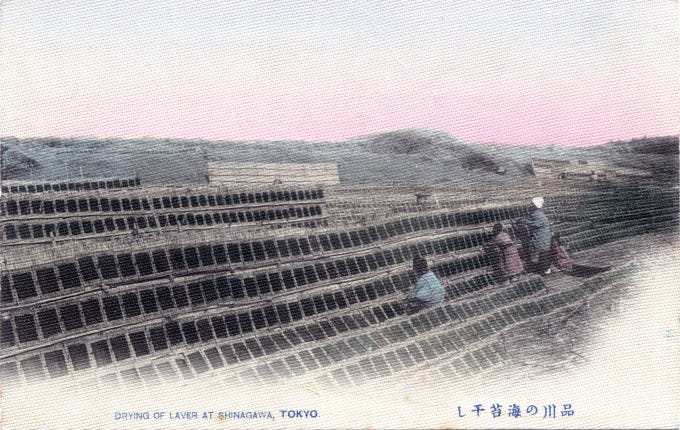
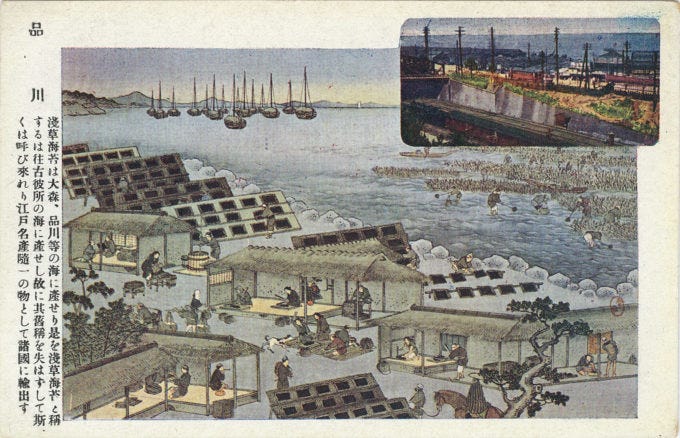
During the Edo period, Shinagawa was a rural post station outside the Edo city limits. Off-shore nori (seaweed) aqua-culture was established by the first Shogun, Ieyasu, when it was discovered lush bushes of algae could be cultivated on wooden piles driven into the bay. Seaweed production around Shinagawa was permanently ended by the 1960s with the opening of the Hamamatsu-Haneda monorail.
From The Connoisseur’s Guide to Sushi: Everything You Need to Know About Sushi Varieties and Accompaniments, by Dave Lowry, 2010:
Nori doesn’t grow naturally in flat sheets. Instead, it collects in little dark green Vandyke beards on rocks or other objects ranging in depth from the tide-line to 25 feet below the surface on the oceans all around Japan.
Collecting it from the sea was difficult and even a little dangerous until the 17th century Tokugawa era, when the Shogun Ieyasu Tokugawa decided he wanted fresh fish served to him on a daily basis. He assigned the fishermen of Shinagawa, a town at the mouth of the Sumida River on the southeast edge of what is now Tokyo, the task of providing the fish.
The fishermen built weirs to keep a steady supply of fish at hand. Before long, they noticed the wooden struts of the weirs were sporting lush bushes of algae, tasty algae of the sort that had previously been harvested only in the wild. Thus was born the nori aqua-culture, which made the tasty treat more affordable.”
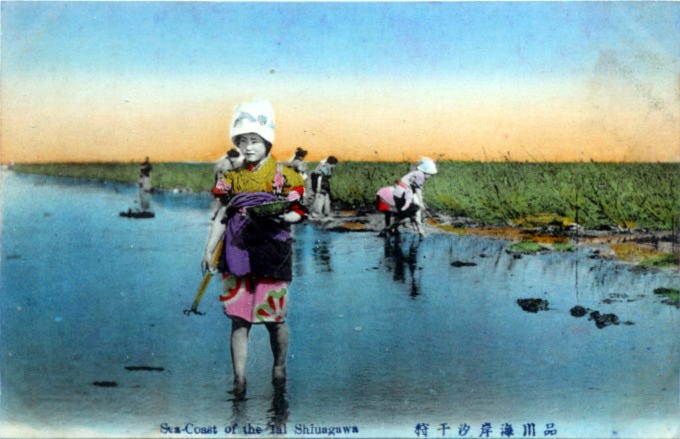
Approaching Shinagawa, we see the forts built in Tokyo Bay during the latter days of the Shogunate, to impede hostile access to the great city, but now dismantled because useless in modern warfare. Owing to the rapid silting up of the bay and of the mouth of the river Sumida, only vessels of light burthen [burden] can proceed beyond this point.
From A Handbook for Travelers in Japan, by Basil Hall Chamberlain & W.B. Mason, 1913
Extensive reclamations of land from the sea have been made here of late years. The numerous factory chimneys seen on nearing Tōkyō are innovation of the last fifteen years. Many, it will be noticed, are of thin iron tubing instead of the usual brick.
This plan is adopted as a safeguard against earthquakes, which natural visitation affects the Tōkyō-Yokohama district with special frequency owing to the fact that (as demonstrated by Prof. John Milne) two lines of seismic activity here intersect.
Just beyond some gas-works, the line skirts past the prettily laid out garden of the Shiba Rikyū, one of the minor Imperial palaces. A little further on, the noble trees in the grounds of the summer palace called Hama Rikyu are seen; and soon after, the train enters the Shinbashi terminus, and the traveler is in Tokyo.
This button is for regular subscriptions:
Monthly: $5
Annual: $30
Special Supporter: $150
At the same time, I want it to be as easy as possible to show your support. That’s why I’ve introduced a sliding-scale annual subscription, where you can choose the level that feels right for you:
“Off-shore nori (seaweed) aqua-culture was established by the first Shogun, Ieyasu, when it was discovered lush bushes of algae could be cultivated on wooden piles driven into the bay.” I would like to draw your attention to the Miyano family home in the Haramachi area of Meguro Ward. This family built a successful business selling bamboo (which grew profusely in this area) to replace the wooden piles which were prone to rot from being submerged in water. Bamboo, on the other hand, was much more water resistant and lasted longer. A visit to the Miyano family home, now a museum, is well worth a visit. See more at http://kominka380.ec-net.jp/
Great introduction to this slice of Japan. I love the postcards. They look hand painted, which would have happened (to postcards and photos).